/

Teaching & consulting

Enseignement & conseil

Motion capture is taught by people who have done it under deadline.

La motion capture s'enseigne par ceux qui l'ont pratiquée sous contrainte de production.

Twenty years on mocap stages and in motion edit departments — and a university curriculum I designed, delivered and was evaluated on. Available to schools, studios building a department, and teams who inherited motion capture without having asked for it.

Vingt ans de plateaux mocap et de départements motion edit — et un cursus universitaire que j'ai conçu, dispensé et fait évaluer. Disponible pour les écoles, les studios qui montent un département, et les équipes qui ont hérité de la motion capture sans l'avoir demandée.

Benjamin has helped a number of less experienced crew to become proficient and do things the right way.

Dejan Momcilovic
Mocap Supervisor & Head of Department
Weta Digital

He taught me a great deal about dealing with stage direction, crowds and planning shoots.

Emile Ghorayeb
Senior Animation Director
DNEG

Compassionate, educational, transparent, concise and clear.

Calum Hart
Senior Producer
Goodbye Kansas

What I deliver

Ce que je propose

5 days · 12–16 students · mocap stage required 5 jours · 12–16 étudiants · plateau mocap requis

Intensive masterclass

Masterclass intensive

The full chain, hands on: planning a shoot, directing performers on stage, cleaning data, retargeting, motion editing, and knowing where animation is still necessary. Students finish with a scene they captured, cleaned and rendered themselves.

Toute la chaîne, en pratique : préparer un tournage, diriger des comédiens sur le plateau, nettoyer les données, retargeter, monter le mouvement, et savoir où l'animation reste nécessaire. Les étudiants repartent avec une scène qu'ils ont capturée, nettoyée et rendue eux-mêmes.

Delivered — Griffith Film School, 2015 Dispensée — Griffith Film School, 2015
1 day or half day · 30+ · no stage required 1 jour ou demi-journée · 30+ · sans plateau

Seminar & conference

Séminaire & conférence

How motion capture actually works in a production pipeline — who uses it, why, and how a small production can engage with it. Built for mixed rooms: industry, teachers, students. Live demonstration where a stage is available.

Comment la motion capture fonctionne réellement dans un pipeline de production — qui l'utilise, pourquoi, et comment une petite production peut s'en emparer. Conçu pour des salles mixtes : professionnels, enseignants, étudiants. Démonstration en direct si un plateau est disponible.

Delivered — Griffith Film School, 2015 Dispensé — Griffith Film School, 2015
Engagement · remote or on site Mission · à distance ou sur site

Building a mocap capability

Monter une capacité mocap

For a school or a studio starting from nothing: what to teach and in what order, how the pipeline should sit inside an existing one, what the stage actually needs, and what it costs to run rather than to buy. The equipment question is the last one, not the first.

Pour une école ou un studio qui part de zéro : quoi enseigner et dans quel ordre, comment le pipeline s'insère dans l'existant, ce dont le plateau a réellement besoin, et ce que coûte son exploitation plutôt que son achat. La question du matériel vient en dernier, pas en premier.

On request Sur demande
2–5 days · animation teams 2–5 jours · équipes d'animation

Training animators on mocap

Former des animateurs à la mocap

Most animators meet motion capture without having chosen it, and resent it because nobody showed them where their craft still applies. It does — and that is what this covers.

La plupart des animateurs rencontrent la motion capture sans l'avoir choisie, et la rejettent parce que personne ne leur a montré où leur métier s'applique encore. Il s'applique — et c'est l'objet de cette formation.

On request Sur demande

Case study

Étude de cas

Griffith Film School & GOBELINS, Brisbane, 2015

Griffith Film School & GOBELINS, Brisbane, 2015

GOBELINS Paris commissioned me to design and deliver a motion capture masterclass for the Griffith Film School, credited inside their Bachelor of Animation. I wrote the whole thing — daily learning objectives, teaching methods, exercises, pipeline diagrams, evaluation forms.

The students were in the final year of a three-year animation degree. They knew Maya keyframe animation. Almost none of them had touched motion capture.

What came of it is on record, from the person who built it. In 2015 the school had no stage: the masterclass ran on a mobile Vicon system, brought in for the week by Logemas, the distributor. Griffith then equipped itself with its own optical stage, and Louise Harvey designed a motion capture course for its animation students. It has run every year since — ten years now — and grown into workshops with the acting programme, student films shot on the stage, and doctoral research.

“The workshop that you ran directly informed the structure of the course.”Dr Louise Harvey, CGI Course Convenor, Griffith Film School — 2026

The following year's course profile already carried the masterclass in its weekly schedule, with an assessed software prerequisite that answers the one criticism the 2015 students had made.

Course Profile 3127GFS, Griffith University, May 2016 · Louise Harvey, September 2026.

GOBELINS Paris m'a confié la conception et l'animation d'une masterclass de motion capture pour la Griffith Film School, créditée dans leur Bachelor of Animation. J'ai tout écrit — objectifs pédagogiques quotidiens, méthodes, exercices, schémas de pipeline, formulaires d'évaluation.

Les étudiants étaient en dernière année d'un cursus d'animation de trois ans. Ils maîtrisaient l'animation keyframe sous Maya. Presque aucun n'avait touché à la motion capture.

La suite est attestée par celle qui l'a construite. En 2015, l'école n'avait pas de plateau : la masterclass s'est tenue sur un système Vicon mobile, apporté pour la semaine par Logemas, le distributeur. Griffith s'est ensuite équipée de son propre plateau optique, et Louise Harvey a conçu un cours de motion capture pour ses étudiants en animation. Il est dispensé chaque année depuis — dix ans aujourd'hui — et il a essaimé : ateliers avec le programme de théâtre, films d'étudiants tournés sur le plateau, recherche doctorale.

“The workshop that you ran directly informed the structure of the course.”Dr Louise Harvey, CGI Course Convenor, Griffith Film School — 2026

Le descriptif de cours de l'année suivante inscrivait déjà la masterclass au calendrier hebdomadaire, avec un prérequis logiciel noté qui répond à la seule critique des étudiants de 2015.

Course Profile 3127GFS, Griffith University, mai 2016 · Louise Harvey, septembre 2026.

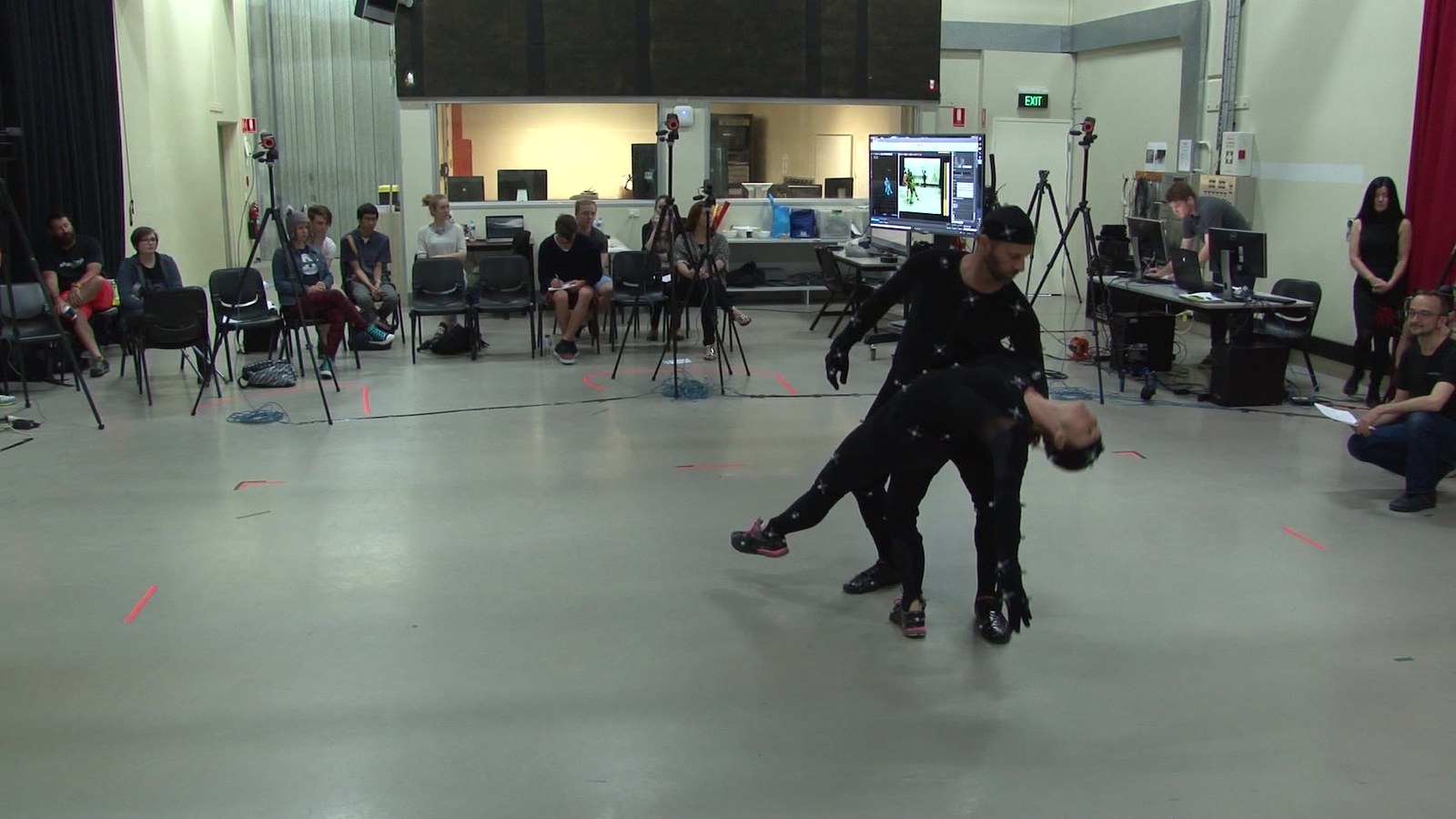
Benjamin Brenneur au bord du volume de capture, Griffith Film School, septembre 2015
On the volume edge, Griffith Film School — September 2015
Au bord du volume de capture, Griffith Film School — septembre 2015
15studentsétudiants
5days on stagejours de plateau
30at the seminarau séminaire
0negative responsesréponse négative
10years the course has run sinceans de cours depuis

Course evaluation, Griffith University, November 2015 — top quartile for teaching effectiveness, no negative response on any question. The seminar was open to Griffith staff and students across Animation, Film and Games, plus the Australian Teachers of Media and the Australian Cinematographers Society.

Évaluation de cours, Griffith University, novembre 2015 — quartile supérieur sur l'efficacité de l'enseignement, aucune réponse négative sur l'ensemble des questions. Le séminaire était ouvert au personnel et aux étudiants de Griffith en Animation, Film et Jeux, ainsi qu'à l'Australian Teachers of Media et l'Australian Cinematographers Society.

The five days

Les cinq jours

From an empty stage to a rendered shot

D'un plateau vide à un plan rendu

Day 1Jour 1

History and technique. Stage orientation, first capture with a live actor. How to prepare a shot and write a shooting call — what a character, props, scale and stage volume actually imply.

Histoire et technique. Orientation plateau, première capture avec un comédien. Préparer un plan et rédiger une feuille de service — ce qu'impliquent réellement un personnage, des accessoires, l'échelle et le volume de capture.

Day 2Jour 2

A full shooting day. Marker sets, biomechanics, reference cameras. Directing actors without costume or set. What can and cannot be captured, and the problems you meet — occlusion, scale, contacts, impacts.

Une journée de tournage complète. Marker sets, biomécanique, caméras de référence. Diriger des acteurs sans costume ni décor. Ce qui peut et ne peut pas être capturé, et les problèmes rencontrés — occlusion, échelle, contacts, impacts.

Day 3Jour 3

Cleaning the data. Lost markers, occlusion, filtering. Actorisation and retargeting, then integrating the character into the set. By the end of the day, a character stands in the décor of their own shot.

Nettoyage des données. Marqueurs perdus, occlusion, filtrage. Actorisation et retargeting, puis intégration du personnage au décor. En fin de journée, un personnage se tient dans le décor de leur propre plan.

Day 4Jour 4

Motion editing. Blends, foot and hand contacts, props, pops. Fixing what the stage left behind before any enhancement work begins — because enhancement on top of a broken take is wasted.

Montage de mouvement. Blends, contacts pieds et mains, accessoires, pops. Réparer ce que le plateau a laissé avant toute amélioration — parce qu'enrichir une prise défectueuse ne sert à rien.

Day 5Jour 5

Enhancement, and judgement. Where is animation necessary, where is it merely possible, and how do you prioritise knowing there is no such thing as perfect capture and no such thing as enough time.

Enrichissement, et jugement. Où l'animation est-elle nécessaire, où est-elle seulement possible, et comment arbitrer en sachant qu'il n'existe ni capture parfaite ni temps suffisant.
What the students wrote

Ce qu'ont écrit les étudiants

Easy going. Everyone kept at the same pace so no one is left behind.

The importance of small movements in order to recreate the emotion of an action, which is more easily obtained using motion capture.

It was really great being taught by a current industry professional who's passionate about what he does.

It was great to be involved in the whole motion capture process, from planning takes in the studio to animating the captured data, in order to give our characters an emotional performance.

Anonymous feedback forms and the university's own course evaluation, Griffith Film School, October–November 2015. The harshest criticism was not about the teaching: the students wanted more time, more facial capture, and more preparation on the software before the week began.

Formulaires d'évaluation anonymes et évaluation de cours de l'université, Griffith Film School, octobre-novembre 2015. La critique la plus dure ne portait pas sur l'enseignement : les étudiants voulaient plus de temps, de la capture faciale, et davantage de préparation au logiciel avant le début de la semaine.

Where this comes from

D'où ça vient

Someone built the training that did not exist. That is the only reason I am here.

In 2003 a Paris studio needed people who could work in MotionBuilder, to make Renaissance — a feature animated entirely from motion capture, and a film no European studio was equipped to attempt. Those people did not exist, because nobody was training them. Rémi Brun, who ran motion capture and motion edit at Attitude Studio, set up a programme with EMCA in Angoulême and made them. I was one of them, and he taught me most of what matters.

Twelve years later, at Weta, we could not hire motion capture specialists either — for exactly the same reason. So when GOBELINS asked me in 2015 how to build a motion capture capability, I gave them the answer I had been on the receiving end of: do not build an isolated mocap course. Teach motion capture inside an animation curriculum, as one of its tools.

The industry has never trained enough of these people. It still doesn't. I have been at both ends of that — the one being trained, and the one doing the training — and the argument has not changed in twenty-two years.

Quelqu'un a construit la formation qui n'existait pas. C'est la seule raison pour laquelle je suis là.

En 2003, un studio parisien avait besoin de gens capables de travailler sous MotionBuilder, pour faire Renaissance — un long métrage entièrement animé à partir de motion capture, qu'aucun studio européen n'était alors équipé pour entreprendre. Ces gens n'existaient pas, parce que personne ne les formait. Rémi Brun, qui dirigeait la motion capture et le motion edit chez Attitude Studio, a monté une formation avec l'EMCA à Angoulême et les a fabriqués. J'en faisais partie, et c'est lui qui m'a appris l'essentiel.

Douze ans plus tard, chez Weta, nous n'arrivions pas davantage à recruter de spécialistes mocap — pour exactement la même raison. Alors quand GOBELINS m'a demandé, en 2015, comment monter une capacité motion capture, je leur ai donné la réponse dont j'avais moi-même bénéficié : ne créez pas une formation mocap isolée. Enseignez la motion capture à l'intérieur d'un cursus d'animation, comme l'un de ses outils.

L'industrie n'a jamais formé assez de ces gens-là. Elle ne le fait toujours pas. J'ai été aux deux bouts — celui qu'on forme, et celui qui forme — et l'argument n'a pas bougé en vingt-deux ans.

You cannot hire a specialist that no school produces. On ne recrute pas un spécialiste qu'aucune école ne produit.

Renaissance, 2004 · Weta Digital, 2015 · still true

Renaissance, 2004 · Weta Digital, 2015 · toujours vrai

Why it matters

Pourquoi ça compte

In 2008, when I was working on Avatar, Weta made roughly one and a half films a year with some four hundred people. By 2015 it was seventeen films, all of them using motion capture to some degree, with fifteen hundred people.

The department could not hire mocap specialists, because nobody was training any. And animators — professionals, good ones — were being handed motion capture without preparation. Many disliked it. Some left the field over it.

That was my diagnosis when GOBELINS asked me, in 2015, how to build a motion capture capability. My answer then still holds: do not build an isolated mocap course. Teach motion capture inside an animation curriculum, as one of its essential tools.

En 2008, quand je travaillais sur Avatar, Weta produisait environ un film et demi par an avec quelque quatre cents personnes. En 2015, c'était dix-sept films, tous intégrant de la motion capture à des degrés divers, avec mille cinq cents personnes.

Le département n'arrivait pas à recruter de spécialistes mocap, parce que personne n'en formait. Et des animateurs — des professionnels, des bons — se voyaient confier de la motion capture sans y avoir été préparés. Beaucoup l'ont détestée. Certains ont quitté le métier pour cette raison.

C'était mon diagnostic quand GOBELINS m'a demandé, en 2015, comment construire une capacité motion capture. Ma réponse d'alors tient toujours : ne créez pas une formation mocap isolée. Enseignez la motion capture à l'intérieur d'un cursus d'animation, comme l'un de ses outils essentiels.

Motion capture is simply a way of putting the human being back into the virtual. La motion capture est simplement un moyen de réintégrer l'humain dans le virtuel.

To GOBELINS, November 2015

Aux GOBELINS, novembre 2015

Contact

Contact

Tell me who you teach, and what they need to be able to do.
The format follows from that.

Dites-moi qui vous formez, et ce qu'ils doivent savoir faire.
Le format en découle.

bbrenneur@gmail.com

Based in France. Teaching in English or French, on site or remote.

Basé en France. Enseignement en français ou en anglais, sur site ou à distance.

Benjamin Brenneur · Motion Edit & Performance Animation